
From black to green
 Energy giants such as Shell and BP are accelerating their moves away from a dependence on oil and heading towards more diversified portfolios – including clean, renewable energy. Richard Young considers the pressures oil companies now face and how their project management capability will be critical as they pivot towards sustainable energy.
Our recent experience, particularly with solar, has given us the expertise and confidence to develop new products and markets alongside our mainstream business. We are now at a point where we have sufficient new technologies and sound commercial opportunities within our reach to build a significant and sustainable business in alternative and renewable energy.” As the world grapples with the consequences of climate change – not least acceleration events such as the Greenland glacier melts and the thawing of carbon-rich tundra in Siberia – it’s reassuring to hear those words from the CEO of BP, one of the world’s largest oil companies.
Except that was then-CEO Lord Browne speaking – in 2005. BP’s journey to a more diversified energy portfolio pre-dates even that, going back to at least 2000, when it rebranded as ‘Beyond Petroleum’. And that journey has been marked by plenty of diversions. In 2011, after Lord Browne’s departure and the Deepwater Horizon disaster on the Gulf of Mexico, BP sold its solar business to release much-needed cash. In 2014, it announced that its only significant ‘alternative’ energy investments would be biofuels. But then in August 2020, newish CEO Bernard Looney told investors that he planned to shrink BP’s oil and gas output by 40 per cent by 2030 and spend $5bn a year building on the group’s renewables businesses instead.
BP’s story isn’t unique. In the wake of the global financial crisis, Shell backed off on its renewables projects too. But an ongoing pan-governmental focus on CO2 reduction has meant renewed interest in efforts to diversify its portfolio. In 2016, Shell launched Shell New Energies to handle its lower-carbon technology projects.
UK prime minister Boris Johnson’s autumn announcement of £160m to help build the next generation of wind turbines is a good example of the financial, as well as regulatory, support that’s increasingly on offer. Johnson has committed the UK to being at the forefront of the green industrial revolution within the next decade, setting a target for the country to reach net zero carbon emissions by 2050 and confirming that offshore wind will produce more than enough electricity to power every home in the country by 2030.
There’s also a branding issue. The generations that fell in love with the motorcar and the jet-set lifestyle are now being replaced by environmentally conscious youngsters who are acutely aware that dire predictions for sea levels and biodiversity are going to come to pass in their lifetimes. ‘Net zero by 2050’ might sound abstract to someone in their 50s, but if you’re in your teens or 20s, it’s an urgent reality. In this year’s sustainability report, Shell CEO Ben van Beurden agreed: “Shell shares this sense of urgency. We continue to take climate action on many fronts, including tackling our own emissions and helping customers reduce theirs.”
By the time Elisabeth Brinton was appointed to run its New Energies division in April 2020, Shell had announced plans to invest $2bn to $3bn a year in low-carbon projects. That’s still just a tiny slice of its estimated $30bn-a-year budget between 2021 and 2025, but it marks a significant shift from even just five years ago. Then, in the autumn, Shell announced Project Reshape, a cost-cutting strategy focused almost exclusively on its oil and gas operations, not renewables.
 Projects or deals?
One dilemma for these vast businesses is that they tend to move slowly – but then, once an inflection point is reached, very quickly. Now things have turned in favour of renewables, it’s dealmakers, not project managers, who have been bulking up the oil giants’ sustainable energy portfolios. Acquiring ready-made capacity can quickly push a business such as Shell or BP into ‘credit’, whereas building projects from scratch is a longer job. For example, in September 2020, BP made its first foray into offshore wind with a $1.1bn acquisition of assets from Norway’s Equinor ASA.
That’s true downstream, too. The rise of electric vehicle sales in the 2020s is a clear threat to petrol forecourt businesses, so Shell’s acquisition of Dutch company NewMotion in 2017, BP’s deal to buy Chargemaster in 2018 and Total’s purchase of the Blue Point London network in September 2020 will get them to green much quicker than working out how to make at-scale forecourt charging viable.
Enter the project managers
These kinds of deals help the oil majors get up to speed, but new projects are now very much on the cards too as they seek to keep up the momentum. “If we find projects that make sense, but where affordability constraints mean we have to make choices, we will probably give preference to the projects that will serve us better in the long-term future,” said Shell’s van Beurden earlier this year.
That means rapid growth in wholly owned or joint venture projects to bring new capacity online. No surprise, then, that majors such as Shell are investing in project management. “The capability to deliver projects is essential for us to be able to forge ahead,” Guus van Ekelenburg, Shell Project Academy Assessment & Accreditation adviser, told us earlier this year. “We use the [APM] assessment process […] in support of our employees’ careers, allowing them to progress to more challenging roles.”
The fly in the ointment is project capacity. Vicki Griffiths, senior project manager at geo-data specialist Fugro, has worked on the development of offshore wind farms for some time. “An uptick in projects means demand for geotechnical and geophysics surveying vessels goes through the roof,” she says. “With a new oil platform, you head to a set of co-ordinates and drill a hole. With an offshore wind farm, the area you need to cover is vast, and each turbine needs its own borehole. So it’s not simply a question of turning on the tap; these projects have demanding and complex development phases.”
Even so, oil companies do have a head start. As BP’s Looney said in September, his company has an edge in renewables “because of our project management skills, experience with partnerships, integration of different departments and openness to digital solutions.”
Where the wind hits the sails
So what does it mean to try and transfer that project management experience? Project caught up with Roeland Borsboom, project director and CEO at Blauwwind, the company behind Borssele III & IV, an integrated project of offshore wind farms powering 825,000 Dutch households. The project is a joint venture between Shell, Partners Group, Eneco, DGE and Van Oord – and it’s a textbook example of how big oil is applying its project management expertise to building a greener future.
Borsboom joined Shell in 1988 as engineer who dabbled, he says, in smaller projects at first. His work – mostly on gas extraction – took him all over the world, and after a decade of pure engineering, he has spent the past 20 years in project management. “There are lots of joint ventures in the sector, so the principles are very familiar,” he says. “When it comes to project management, there’s very little difference. You have to understand the risks and uncertainties, just like oil and gas.”
In oil and gas, for example, there are risks around how you get natural resources out of the ground, whereas an offshore wind farm has to account for weather risks. Then there’s commercial risk. Oil platforms, pipelines and refineries are expensive, so project development includes a huge amount of forecasting around costs and long-term revenue projections.
“As a projects guy, you have to try and keep it simple,” says Borsboom. “You rely on people accounting for those risks in the early development phase. We could be talking about a five-year project to get a facility up and running, so looking back is fruitless. A project manager lives and dies by decisions that are intended to implement the business case well, not by challenging the business case.”
That’s not to say finances, taxation, predicted power prices and regulation won’t change the rationale over time. But that’s what makes the oil majors such a good fit for large-scale renewable projects: they’ve been making those calculations for decades. There are differences from deep-sea drilling, of course. Off the coast of Britain, you have to weigh up the conditions of any lease on Crown Property, for instance. And VAT kicks in for projects with kit inside the UK’s 12 nautical miles of territorial waters.
“You’re talking about a commercial rationale for projects based on an economic life of 25 years,” says Borsboom. “Then you look at the engineering and see whether you can extend its life. The big difference, of course, is that an oil deposit will eventually run out regardless of the condition of a platform. The wind won’t.”
Griffiths adds that working in inshore waters introduces other project risks. “For example, the environmental impact assessments are really important,” she says. “You’re covering a much bigger area of the seabed with a wind farm than with an oil platform, and a wind farm is usually in shallower waters with richer ecosystems. If you encounter a protected sabellaria reef on the geophys survey, for instance, that can create a huge problem for a project.” Equally, drilling bore holes in Dogger Bank, which was inhabited during the last Ice Age, can trigger archaeological regulations.
Big is beautiful
The other thing that project managers from the oil and gas sector are well acquainted with is scale. Rooftop solar panels wouldn’t scratch the surface of an oil major’s carbon footprint, but the MHI Vestas V164 turbines used by Blauwwind have a rotor diameter of 164m. Even a Boeing 747’s 68m wingspan looks puny by comparison. The turbines sit more than 100m above sea level, and each of the three blades weighs around 34 tonnes. And, as Borsboom points out, the turbine nacelle is twice the size of his house.
“The skills are very complementary,” says Borsboom. “I always quote the CEO of a turbine manufacturer who once said that ‘offshore wind’ is about 10 per cent making the most of the wind and 90 per cent doing it offshore. The installation phase looks a lot like an oil platform. You have massive construction requirements, you’re running undersea cabling to transformer stations and you’re dealing with ocean conditions and steelworks, just as you would with an oil platform.”
And here’s another example of the overlap: the three major project safety risks for Shell’s whole portfolio of operations are heavy lifts, dropped objects and marine operations. “We have all three,” says Borsboom. “And even with all that [culture from Shell], safety remains a significant challenge for large-scale offshore wind projects. Blauwwind has 77 assets – that’s about 500 heavy lifts in total to get the project finished, compared with four or five for an oil platform.”
Charging ahead
Of course, there are some big differences too. Griffiths points out that while project managers on oil platforms will undoubtedly make safety a top priority, onshore and near-shore wind farms are more than likely covered by the complex Construction (Design and Management) Regulations as well. “That’s a lot more paperwork,” she says, “including submitting plans to the Health and Safety Executive, ensuring public safety – after all, you don’t get many pleasure-boaters visiting oil platforms deep in the North Sea – and more onerous documentation of processes”.
Add in the broader stakeholder considerations – not everyone is a fan of wind farms that can be seen from shore, and they can disrupt businesses such as fishing – and there’s still plenty that the oil and gas project manager can learn from those steeped in renewables.
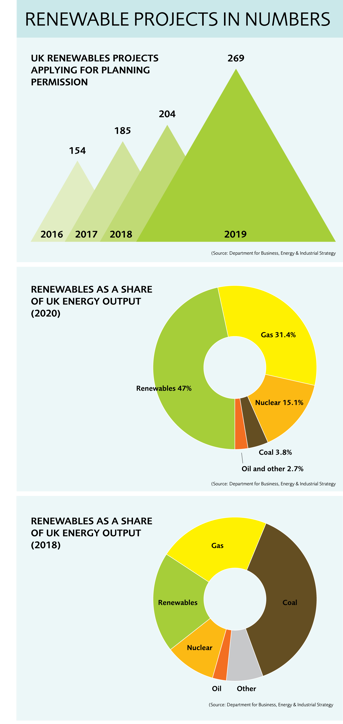
But the scale of these projects is only going to get bigger. While the growth in low-carbon power production has been impressive, there’s still a long way to go. That means more solar, more wind, perhaps geothermal and biomass energy sources… and, controversially, more nuclear.
The engineering is, thankfully, keeping pace. Borsboom points out that GE is now working on the Haliade-X, a 220m-high turbine with huge blades that will be capable of powering 16,000 homes. And the bigger the scale, the more crucial the project management discipline. With the oil majors showing real commitment to the shift from black gold to green power – and marrying their formidable project management expertise to that of existing players such as Fugru – there’s real hope that the global targets can be met. That’s a valuable dose of optimism in the wake of a year that has shown just how much the world needs big solutions.
0 comments
Log in to post a comment, or create an account if you don't have one already.